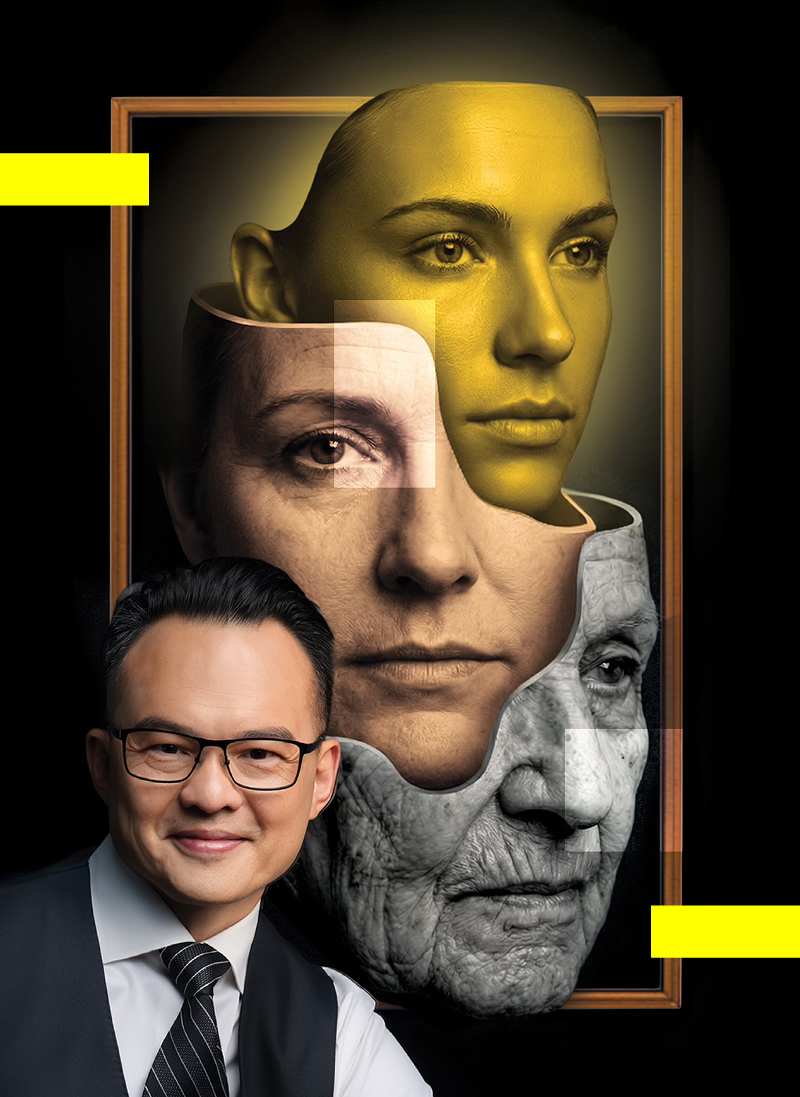


Yuta Lee
The Age Engineer
On time as a design problem. Regenerating organs, training cells. And rebooting the human system
WHO HE IS
-
A time hacker of human biology. A longevity scientist probing not just how long, but also how well life can last.
-
Founder and CEO of Accelerated Bio, Lee studies the most common feature of the living - aging and subsequent death. Not as fate, but as a biological program that can be slowed, altered, and maybe eventually even rewritten.
-
Lee’s company is pioneering a new kind of therpay - with cells taken from the lining of the placenta of a non-viable pregnancy where the fertilised egg fails to attach to a mother's uterus, and implants outside. A rare condition that account for only 2% of all pregnancies.
- These cells, called trophoblasts, are recovered from embryos that would otherwise be discarded to save in-danger mothers. A process first done by Lee's father Jau-nan Lee back in 2003. These are some of the earliest stem cells available, and Lee calls them the "NVIDIA chips" of the human body. Because with them, he's focusing on stopping and reversing the mechanisms that cause cells, tissues, and systems to deteriorate over time. Senescence. DNA damage. Metabolic decline. The quiet accumulation of errors that cumulatively manifest as ailments.
-
Fun fact: there are already enough trophoblast cells in the company’s bank to come to the rescue of 2 trillion humans.
REPROGRAMMING TIME
-
For most of history, medicine has treated aging as an inevitable backdrop against which disease occurs. Lee is challenging that assumption.
-
Aging, he argues, is the primary risk factor for nearly every chronic disease: cancer, neurodegeneration, cardiovascular failure. Treat the disease and you can fight downstream symptoms.
-
His research focuses on upstream control points. Cellular repair systems. Metabolic pathways. Signals that tell cells when to divide, when to rest, when to self-destruct. This is like surveilling and manipulating biology. Watching deterioration unfold and intervening before collapse.
-
Cells remember damage but they can also forget. Under the right conditions, tissues can regain youthful function. Repair mechanisms can be reactivated. Decline can be delayed. Lee explores how interventions - genetic, pharmacological, lifestyle, and regenerative - might reset aspects of biological time without destabilizing the organism underneath.
-
This reframes aging as a dynamic process rather than a one-way slide. Not immortality. Not fantasy. But incremental control over how fast the clock ticks. A wager that the body’s own resilience can be amplified if we learn how to listen to its signals.
THE BIG DEBATE
-
Extending healthy life raises questions.Who gets access to longevity therapies? Will they widen inequality or eventually become as universal as vaccines? If people live longer, how do societies adapt economically, politically, psychologically?
-
Lee emphasizes responsibility alongside innovation. Longevity without equity risks becoming extraction by another name.
-
There is also the question of purpose. If life expands, how do we fill it? How do careers, relationships, and institutions evolve when time horizons stretch? Longevity science does not merely alter biology. It forces a redesign of social contracts built around short and certain-to-end lives.
AT SYNAPSE
Yuta Lee will take us inside the new science of aging. Revealing how biology reflects time, why it fails, and where intervention may be possible. He will unpack how longevity research is shifting medicine from reaction to prevention; from treating disease to engineering durability. And will ask the critical question at the heart of it all: if aging can be slowed, how do we re-evaluate life, longevity and meaning?